Most agencies do not need another massive dashboard. They need an audit workflow that finds meaningful issues, turns them into clear recommendations, and helps the team prove progress to clients.
The best SEO audit tool alternatives depend on the work we do every week. A technical SEO team needs crawl depth. A growing digital agency may need client-ready reports, lead capture, keyword context, and a practical view of AI visibility. Choosing the wrong platform usually creates more exports, more tabs, and less action.
The Best Alternatives at a Glance
These platforms solve different parts of the audit process, so the smartest choice is often a focused stack rather than a one-tool replacement.
| Tool | Best For | Standout Strength | Watch Out For |
|---|---|---|---|
| Screaming Frog | Deep technical reviews | Flexible desktop crawling | Steeper learning curve |
| Ahrefs | Competitive research | Backlink and keyword data | Higher monthly cost |
| Semrush | Broad agency operations | Reporting, rankings, AI visibility | Add-ons can increase spend |
| Google Search Console | Indexing diagnosis | First-party Google data | Limited prioritization |
| PageSpeed Insights | Performance checks | Field and lab speed data | Not a full audit platform |
| Marvlus | Lead-focused agency audits | White-label audits and AI visibility | Not built for raw log-file analysis |
What a Useful Agency Audit Tool Must Do
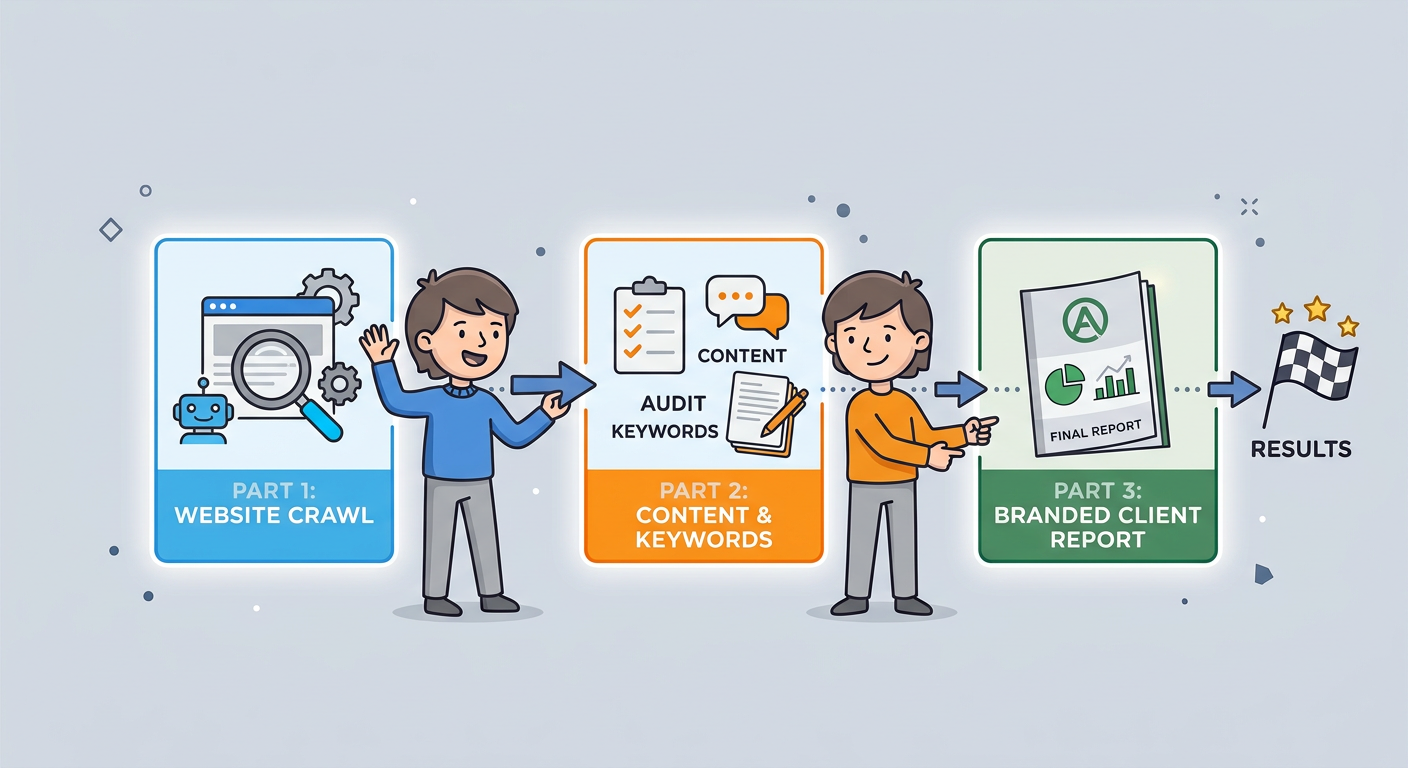
A useful audit tool should help us decide what to fix first, not just produce a long list of warnings. For early-stage SEO, AEO, GEO, and digital marketing agencies, the winning platform creates a bridge between diagnosis, delivery, and revenue.
We recommend evaluating every option against five questions:
- Can it uncover real technical blockers? Broken internal links, duplicate content, redirect chains, indexing problems, and rendering issues still matter.
- Can it add business context? A missing title tag is not automatically urgent. A weak service page that supports paid acquisition or a core sales offer is.
- Can clients understand the output? Clear priorities, plain-language explanations, and ownership make recommendations easier to approve.
- Can it support AI visibility work? Agencies increasingly need to review topical coverage, clear entity signals, answer-friendly structure, and prompt visibility alongside traditional rankings.
- Can it fit the agency’s sales process? If the audit can educate a prospect before a sales call, it becomes more than fulfillment software.
Google’s own tools remain an important part of the foundation. The URL Inspection tool helps confirm whether Google can index a specific page, while PageSpeed Insights combines lab diagnostics with real-user experience data. Neither tool replaces an agency workflow, but both provide high-value evidence when a client challenges a recommendation.
1. Screaming Frog for Technical SEO Depth
Screaming Frog is a strong choice when we need to crawl a site thoroughly and control exactly what the crawl checks. It is especially useful for migrations, ecommerce sites, JavaScript rendering reviews, duplicate-content analysis, and custom extraction.
The free version crawls up to 500 URLs. Its paid license costs $279 per year per user and adds unlimited crawling, scheduled crawls, integrations, custom JavaScript, and broader analysis features, according to Screaming Frog’s pricing page.
Best fit
We would choose Screaming Frog when a client site has a technical issue that other platforms summarize too broadly. It gives experienced practitioners the detail to locate the actual problem, then export evidence for developers or internal stakeholders.
Tradeoff
It does not naturally turn crawl data into a polished, prospect-friendly audit experience. We still need a process for prioritization, client communication, task management, and reporting.
2. Ahrefs for Competitive SEO Intelligence
Ahrefs is a practical alternative for agencies that need site audits alongside serious backlink, keyword, and competitive analysis. Its Site Audit, Site Explorer, Keywords Explorer, rank tracking, and AI prompt tracking can make it a central research tool for teams managing active SEO campaigns.
Ahrefs lists its Lite plan at $129 per month, with five projects, 750 tracked keywords, 100,000 crawl credits, and five tracked AI prompts. Its Standard plan is $249 per month and expands project, keyword, crawl, and historical-data limits, according to Ahrefs pricing.
Best fit
We would use Ahrefs when a client asks, “Why is that competitor ahead of us?” It is strong for analyzing link gaps, estimating organic visibility, examining top pages, and identifying topic opportunities before we write a content brief.
Tradeoff
Ahrefs is a research powerhouse, but it can be more platform than a newer agency needs on day one. It also is not designed around embedded, white-label lead magnets that generate qualified prospects from an agency website.
3. Semrush for Broad Agency Reporting
Semrush works well for agencies that want a large all-in-one environment with site auditing, position tracking, keyword research, competitor analysis, reporting, and growing AI visibility capabilities. It is often the closest replacement for teams trying to consolidate several marketing tools.
As of 2026, Semrush lists its SEO plan at $139 per month when billed monthly. The Starter plan, which includes 50 daily prompt checks and AI-ready site audit features, is listed at $199 per month. Its Pro Report add-on costs $20 per month and includes white-labeling, scheduled delivery, and link sharing, based on Semrush pricing.
Best fit
We would choose Semrush when our agency manages multiple channels and needs a familiar, enterprise-ready platform. Its reporting options and broad toolset make it appealing for established teams with defined processes.
Tradeoff
The broader the platform, the more important governance becomes. Without a standard operating process, teams can spend too much time collecting metrics and too little time deciding which client action will create progress.
4. Google Search Console and PageSpeed Insights for Proof
Google’s free tools are non-negotiable companions, even if they are not complete SEO audit platforms. They provide the strongest direct evidence for indexing, performance, and organic visibility questions tied to a verified property.
Use Search Console to inspect important URLs, investigate indexing statuses, review page performance, and validate fixes. Use PageSpeed Insights to discuss mobile and desktop performance with both field data and controlled lab data.
Best fit
These tools are ideal for validating a recommendation. If we tell a client that a landing page may not be indexed, a Search Console inspection is much more persuasive than a generic crawler warning.
Tradeoff
They do not organize a full agency audit, connect problems to sales opportunities, or package recommendations into an easy prospect experience. They tell us what Google sees, but not necessarily what our next client-facing move should be.
5. Marvlus for White-Label Audits and Lead Generation
Marvlus is worth considering when the audit needs to do double duty as a sales asset and a fulfillment tool. It is designed for agencies that want to embed a branded audit experience, collect leads, share white-label reports, and review SEO plus AI visibility signals in one workflow.
For early-stage agencies, that matters because the audit should not sit in a spreadsheet after the first call. It should give prospects immediate value, reveal where their site needs help, and create a natural reason to book a deeper strategy conversation. Marvlus also supports a workflow around topic coverage and AI visibility, which aligns with the growing need to make pages easier for answer engines to interpret.
If you are building a service line around AEO or GEO, the AI search optimization tools workflow can help frame audits around content clarity, brand signals, topical authority, and technical accessibility rather than rankings alone.
Best fit
We would use Marvlus when a small or growing agency wants less friction between a visitor’s first audit and the agency’s sales pipeline. The agency audit and lead generation tools are particularly relevant for teams that need branded widgets, shareable reports, and a cleaner way to turn website traffic into qualified conversations.
Tradeoff
It is not a replacement for specialized technical tools when the assignment demands deep crawl configuration, custom extraction, server-log analysis, or forensic migration work. In those cases, pairing it with Screaming Frog is often more effective than forcing one tool to perform every job.
Build a Day 9 Audit Stack Without Overspending
On Day 9, early-stage agencies should build a repeatable audit system, not chase a perfect software suite. The goal is to create a small workflow that produces an informed recommendation in under 90 minutes for a qualified prospect.
We suggest this sequence:
Start with the prospect’s money pages
Review the homepage, core service pages, top lead-generation pages, and a small sample of recent content. We are looking for unclear positioning, thin service information, weak calls to action, and pages that do not directly answer the buyer’s question.
Confirm technical and indexing reality
Run a targeted crawl with Screaming Frog or a comparable crawler. Then validate the highest-impact concerns in Google Search Console and PageSpeed Insights whenever verified access is available.
Add competitive context
Use Ahrefs or Semrush to review the client’s closest organic competitors. Look for the competitor pages that earn relevant traffic, the topics the prospect has not covered, and links or page types that point to a larger authority gap.
Convert findings into three priorities
Avoid handing a prospect 80 problems. Give them one technical priority, one content or topical priority, and one authority or conversion priority. Each recommendation should state the expected business impact, the owner, and the next action.
Make the audit part of the sales experience
Use a branded, client-friendly audit that helps visitors understand their own gaps before they talk to us. The agency growth lesson is simple: prospects rarely buy a spreadsheet, but they do buy clarity and a believable path forward.
For more context on using an audit offer to build an agency pipeline, read this detailed guide on building an SEO company through helpful lead generation.
How We Would Choose Between These Tools
The right alternative is based on the bottleneck in our business, not the longest feature list. Agencies that make this decision well buy the tool that strengthens their weakest operational link.
- Choose Screaming Frog when technical accuracy and crawl control are the priority.
- Choose Ahrefs when competitor, link, and keyword intelligence guide the work.
- Choose Semrush when a broad agency platform and formal reporting are more important than simplicity.
- Choose Google Search Console plus PageSpeed Insights when we need first-party confirmation at no extra software cost.
- Choose Marvlus when branded audits, lead capture, AI visibility, and client-ready recommendations are central to the business model.
Frequently Asked Questions
Can we run client audits with free tools only?
Yes, we can handle basic audits with free tools, especially for small websites. Google Search Console, PageSpeed Insights, and the free version of Screaming Frog can reveal valuable issues, but reporting, competitive research, automation, and client management will require more manual work.
Which option is best for a new SEO agency?
For a new SEO agency, we would start with Google’s free tools and Screaming Frog, then add a platform based on our sales model. If lead generation and branded reporting are the immediate priority, an embedded audit tool can offer a faster path to conversations than a broad research subscription.
Do AEO and GEO agencies need a separate audit process?
They need an expanded process, not an entirely separate one. Technical SEO, useful content, clear business information, and strong internal linking still matter, but we should also assess answer-friendly formatting, topic depth, entity clarity, and brand mentions across AI platforms.
Is a white-label report worth paying for?
It can be, if it improves how clients perceive and act on our work. White-labeling is valuable when the report is part of a consistent agency experience, but it will not compensate for vague recommendations or poor client communication.
How often should agencies audit client websites?
We recommend a lightweight monthly check for active clients and a deeper audit quarterly, after major releases, or before a migration. High-traffic ecommerce, publishing, and SaaS sites may need more frequent technical monitoring.
Can an audit tool replace an SEO strategist?
No. Tools find signals and patterns, but strategy requires judgment about business priorities, audience intent, resources, and tradeoffs. The best agencies use software to reduce repetitive analysis so people can spend more time making good decisions.
Turn Audit Data Into Agency Momentum
A strong audit stack should make our agency easier to buy from and easier to trust. Start with one reliable technical source, one competitive intelligence platform if the budget allows, and a client-facing process that converts findings into practical work.
The agencies that win with SEO audit tool alternatives are not the ones with the most dashboards. They are the ones that consistently identify the next meaningful fix, explain it clearly, and show clients how the work connects to visibility, leads, and revenue.
Give Prospects a Useful First Win
Want to turn more site visitors into qualified SEO, AEO, or GEO conversations? Try Marvlus to add a branded AI and SEO website audit to your agency site, share white-label reports, and give prospects a clearer reason to work with you.