You want people and AI tools to surface your site when prospects ask ChatGPT for answers, and that goal is more achievable than you think. In this guide I’ll walk you through a practical, prioritized plan so you can start increasing AI visibility fast. First, here’s the core idea: make your pages easy for AI crawlers to find, simple for models to quote, and clearly authoritative to earn mentions.
When you read below you’ll see a mix of technical checks, content tactics, and outreach steps that together improve chances your site is used, recommended, or cited inside ChatGPT and other generative answer engines. Follow the checklist, set realistic milestones, and run an AI visibility audit to track progress.
What does it mean to “get my website on ChatGPT”?
Getting your site on ChatGPT means one or more of these outcomes: the model uses your content to answer user queries, your page is included as a clickable source when web browsing is used, or your content influences the model’s recommendations. It does not guarantee a permanent placement—AI systems weigh many signals, and visibility evolves as models and crawlers update.
Here’s the thing, there are two main technical paths that matter: (1) allow the right AI crawlers access to your content, and (2) structure your content so it can be extracted, summarized, and cited easily.
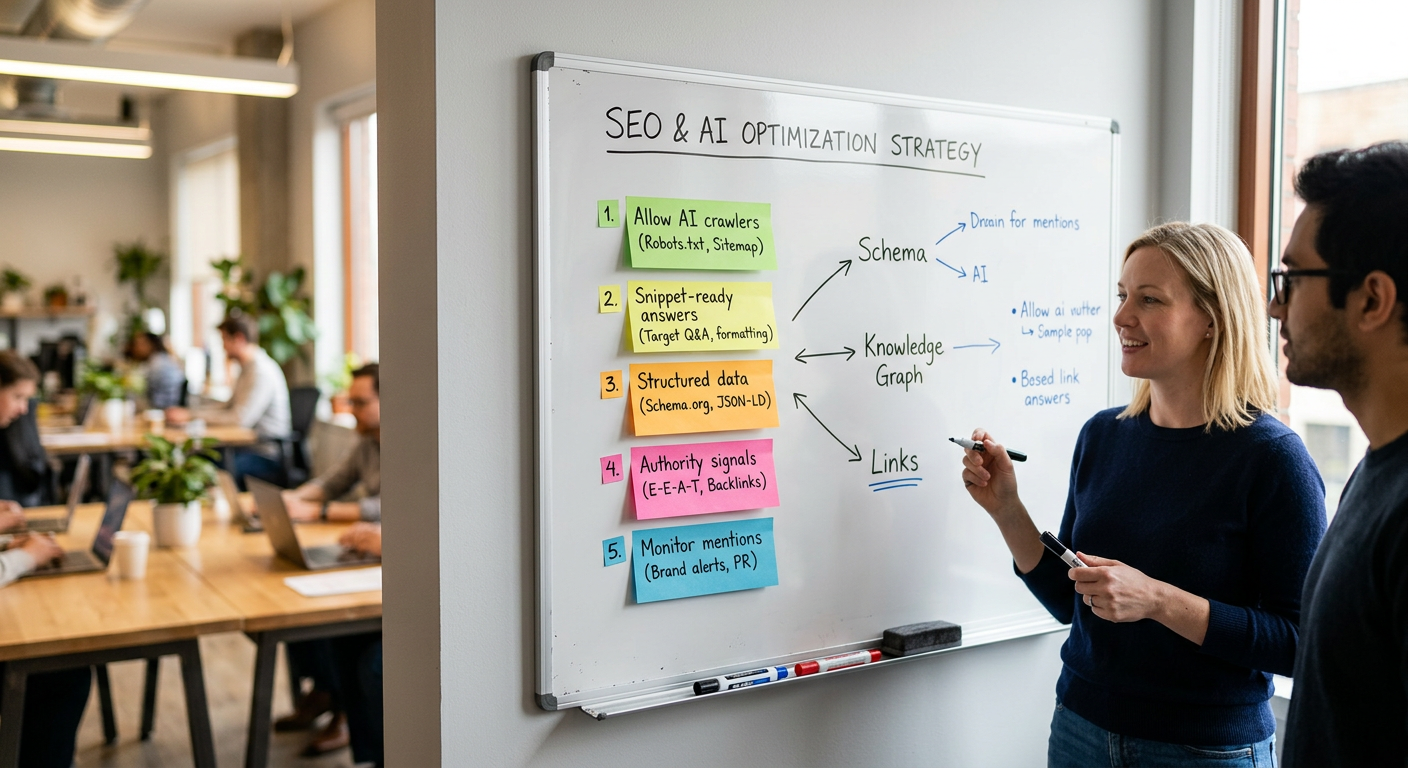
Quick technical checklist (do these first)
1) Check crawler access and robots.txt
- Ensure you are not blocking major AI crawlers like GPTBot or OAI-SearchBot in robots.txt. If you want to be discoverable, allow those agents. If you’re unsure where to start, consult publisher guidance from major AI platforms for current user-agent names and recommendations.
- Verify your robots.txt is served correctly, not returning 403 or redirect loops.
2) Confirm pages are crawlable and indexable
- Noindex tags and login walls block discovery. Use a simple HTML test page to verify your public pages return 200 and are crawlable.
- Make sure your sitemap.xml is up to date and submitted to search engines, because many AI systems rely on the same discovery pipelines.
3) Improve page performance and mobile friendliness
- AI systems still prefer fast, stable pages. Fix big Core Web Vitals issues, reduce blocking scripts, and serve compressed images.
Content changes that make AI more likely to reference you
4) Create snippet-ready answer blocks
- Write short 40–70 word answer paragraphs near the top that directly answer a single question. These act like micro-answers AI can quote or paraphrase.
5) Use clear headings and structured sections
- Use H1/H2/H3 to label Q&A sections, step lists, and definitions. AI models prefer content that’s chunked logically and labeled so extraction is easy.
6) Add structured data where relevant
- Schema markup for articles, FAQs, products, and recipes helps machines understand your content and may increase the chance of being surfaced in AI answers.
7) Author, date, and E-E-A-T signals
- Include author bios, credentials, published dates, and sources. Demonstrable expertise and trust signals improve selection probability.
Outreach and signal-building (authority + mentions)
8) Earn topical citations and backlinks
- Get linked, mentioned, and quoted by authoritative sites in your niche. Citations across trusted sources increase the chance an AI system recognizes your site as a credible reference.
9) Syndicate and publish canonical summaries
- Publish concise explainers or canonical FAQs that other sites can link to or cite. Supply embeddable snippets or quote-ready summaries that make it easy for others to reference you.
10) Monitor and iterate
- Use log analysis, brand monitoring tools, and referral reports to detect ChatGPT or AI-driven referrals. Track changes after each technical or content update so you know what worked.
Common objections and how to address them
- "I’m worried about my content being scraped" — You can selectively opt out of training ingestion in robots.txt if you prefer, but opting out reduces AI visibility. Decide based on business priorities.
- "This is just like SEO" — It is similar, but AI visibility emphasizes snippet-ready clarity, structured answers, and cross-site recognition more than keyword density.
- "We don’t have dev resources" — Start with high-impact, low-effort tasks: create 3–5 snippet-ready sections on your existing pages, fix one robots.txt rule, and add JSON-LD FAQ markup.
Practical 30/60/90 day plan
- Days 1–30: Robots.txt check, sitemap update, fix one high-traffic page with a snippet-ready lead paragraph, add FAQ schema.
- Days 31–60: Audit 5 top pages, improve E-E-A-T (author bios, references), outreach to get 3 authoritative mentions.
- Days 61–90: Monitor logs for AI crawlers, measure referral changes, expand snippet-ready sections to 10 pages, run another AI visibility audit.
Tools and resources
-
Run an AI visibility audit to identify crawl blocks, schema gaps, and snippet opportunities with a quick site scan. If you want a plug-and-play audit widget you can embed on your site, consider using Auditsky’s free AI website audit that reports SEO and AI visibility signals. You can also explore Auditsky’s agency tools for embedding audits on client sites to generate leads.
-
Read platform publisher guidance and crawler docs before changing robots.txt so you understand the impact on training vs search crawling.
Frequently Asked Questions
How long until ChatGPT uses my content?
There’s no guaranteed timeline. If crawlers are allowed and your content is well-structured, you may start seeing references in weeks to months depending on crawler schedules, model updates, and how often your pages are cited elsewhere.
Will allowing GPTBot let OpenAI train on my site?
OpenAI’s documentation explains how GPTBot and other agents operate and how publishers can opt out if they choose. If you allow GPTBot, your public content may be used for model training depending on platform policy.
Do I need to add special meta tags just for ChatGPT?
No single meta tag guarantees appearance. Focus on robots.txt for crawler access, structured data for understanding, and snippet-ready content for quotability.
Can ChatGPT provide a backlink to my site?
When ChatGPT uses web browsing to gather sources, it can return clickable citations. Those are not guaranteed, and they may depend on the browsing mode or the user’s subscription.
Is this the same as Google SEO?
There is overlap, but AI visibility emphasizes concise answers, extraction-friendly structure, and cross-site recognition. Traditional SEO still matters a great deal.
How do I track if ChatGPT is sending traffic?
Watch referral reports for utm_source and monitor server logs for known OpenAI user agents, plus use brand mention tools that track AI citations across platforms.
Should I block AI crawlers to protect content?
Blocking protects content from training ingestion but reduces chances of being cited. Choose based on business model, licensing, and privacy needs.
Next step you can take today
Ready to audit your site for AI visibility? Run a free AI + SEO audit on Auditsky to get a prioritized checklist and sample report that you can use in client pitches or your own roadmap. Explore the agency embedding options if you want to capture leads from visitors who run audits on your site.
Want help implementing this on your site?
If you’re an agency or site owner and need a fast, hands-on audit with prioritized fixes and an embed option to convert traffic into leads, try Auditsky’s free AI website audit or check the agency tools page for white-label options and guides.
- Start a free audit: https://auditsky.ai/
- Agency embedding options: https://auditsky.ai/agencies
- AEO primer and FAQ: https://auditsky.ai/newsletter/what-is-aeo/
Wrap-up
Getting your website referenced in ChatGPT is a mix of technical hygiene, content design, and reputation building. Start with crawlability and snippet-ready content, measure changes, and scale what works. This approach increases your chances of being used as a source by AI tools while improving traditional SEO and conversions at the same time.