Free SEO website audit
Find the SEO issues holding your site back.
Run a free SEO website audit in about 60 seconds. Check titles, headings, metadata, internal links, indexability, and technical issues, plus AI visibility signals, and get a clear list of what to fix first.
Free SEO audit · Takes about 60 seconds · No credit card required
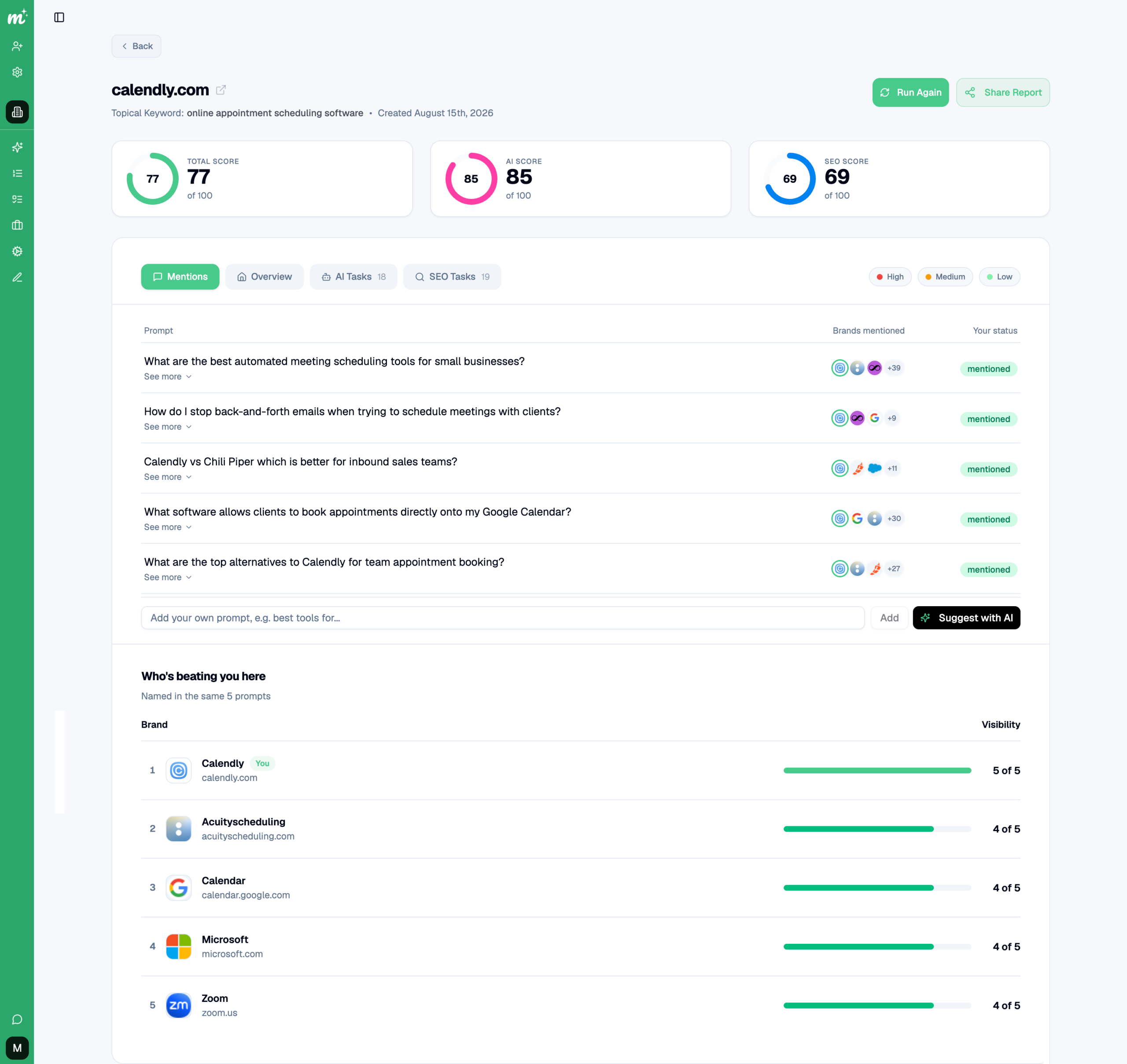
See what search engines see on your page.
Most SEO problems are invisible to the people who run the website. A missing meta description, a stray noindex tag, or a confusing heading structure can quietly hold a page back for months. This audit surfaces those issues in plain language, so you know what is working and what needs attention.
On-page SEO
Review titles, meta descriptions, headings, keywords, internal links, and image alt text.
Technical SEO
Find crawling, indexing, canonical, redirect, and robots issues that limit visibility.
Content
Check readability, structure, depth, and how well the page matches search intent.
What is a free SEO website audit?
A free SEO website audit is an automated review of a webpage that checks the on-page, technical, and content factors search engines rely on to crawl, understand, and rank it. Instead of guessing why a page is not performing, you get a structured list of issues and opportunities, organized by category and written so anyone can act on it.
Search engines need to read the page.
Before a page can rank, search engines must be able to crawl, render, and index it. Technical checks confirm that nothing is blocking that process, from robots directives to broken canonical tags.
Then they need to understand it.
Clear titles, descriptive headings, focused content, and helpful internal links tell search engines what the page is about. On-page checks show whether those signals are strong, weak, or missing.
From URL to SEO action plan in three steps.
No complicated setup. No plugin installation. Start with any public page and get a practical SEO report showing what deserves your attention.
Enter your URL
Paste the address of the page you want to check. Start with your homepage or your most important service or product page.
We run the SEO checks
The audit reviews on-page, technical, and content signals, along with AI visibility, and organizes the findings into a readable report.
Fix what matters
Review what is working, what needs attention, and which issues to tackle first to make the page easier to find.
Dozens of SEO signals. One simple report.
The audit looks beyond a single score. It shows the individual on-page, technical, and content signals that influence how easily search engines can find, understand, and trust your page.
AI visibility & answer-readiness
- Clear page summary
- Brand clarity
- Primary topic clarity
- Question-and-answer content
- FAQ content
- Entity signals
- Related topic coverage
- Content depth
- Descriptive headings
- Answer-friendly formatting
- Structured lists and steps
- Supporting evidence
- Business information
- Content consistency
- Freshness signals
SEO & on-page optimization
- Title tag
- Meta description
- Primary keyword signals
- H1 heading
- Heading hierarchy
- Keyword placement
- Related terminology
- Internal links
- External references
- Image alt text
- Canonical URL
- Indexability
- URL structure
- Open Graph data
- Structured data
Technical website signals
- HTTPS
- Mobile viewport
- Responsive structure
- Broken links
- Redirect issues
- Robots directives
- XML sitemap
- Robots.txt
- Canonicalization
- Page resources
- Crawler accessibility
- JavaScript dependence
Content quality & structure
- Readability
- Paragraph length
- Descriptive headings
- Search intent alignment
- Thin content
- Duplicate content signals
- Calls to action
- Content hierarchy
- Topic completeness
What does a page need to perform well in search?
There is no single trick that makes a page rank. Search performance depends on relevance, quality, technical accessibility, and the competition for each search. But the factors on your own website are the ones you control, and they are where most improvements start. These are the fundamentals a good SEO audit checks.
Write a title tag that earns the click.
The title tag is often the first thing a searcher sees. It should describe the page accurately, include the main topic near the beginning, and stay short enough to display fully. A unique, specific title helps search engines and people understand why this page is the right result.
Use one clear H1 and logical headings.
A single descriptive H1 tells visitors and search engines what the page covers. Supporting H2 and H3 headings should break the content into scannable sections. A clean heading hierarchy makes long pages easier to read and gives search engines extra context about each section.
Match the intent behind the search.
Ranking depends on whether the page satisfies what the searcher actually wants. Someone searching for a price needs pricing, and someone comparing options needs a comparison. Review the page from the searcher’s perspective and make sure the most important answer is easy to find.
Make sure the page can be indexed.
A page cannot rank if search engines cannot crawl or index it. Accidental noindex tags, robots.txt rules, incorrect canonical tags, and redirect chains are common culprits. These issues are easy to miss and can have an outsized effect on visibility.
Connect pages with internal links.
Internal links help search engines discover pages and understand how topics relate. Link important pages from relevant content using descriptive anchor text. Pages with few or no internal links can be harder to find, both for visitors and for crawlers.
Add structured data where it fits.
Structured data, or schema markup, describes the page in a format search engines can read directly. Organization, product, article, FAQ, and local business schema can clarify important details. Use it to reflect what is genuinely on the page, never to add information that is not there.
How does a free SEO audit compare to paid tools?
Paid SEO platforms can crawl entire sites, track rankings, and analyze backlinks. A free page-level audit has a different job: giving you a fast, understandable view of what to fix on the pages that matter most.
Paid SEO platforms
Full-featured SEO suites are built for ongoing work across large sites. They typically offer site-wide crawls, keyword and rank tracking, backlink analysis, and competitive research. They are powerful, but they often come with a learning curve, a monthly subscription, and more data than a busy website owner needs to make a decision.
A free page-level audit
A free page-level audit focuses on a single URL and translates its on-page, technical, and content signals into clear findings. It is fast, requires no setup, and is a practical way to check important pages, validate changes, and decide where to focus before investing in larger tools or professional help.
The practical takeaway: start with the pages that matter most and fix the clear issues first. Fundamentals are often where the biggest opportunities are hiding. If you also want to know how your site appears in AI-powered search, run our free AI website audit to review AI visibility signals alongside SEO.
Good SEO is still the foundation for AI search.
People now find businesses through traditional results, AI-powered search experiences, and conversational assistants. The pages that perform well across all of them tend to share the same traits: they are crawlable, clearly structured, genuinely useful, and easy to trust.
Fix SEO issues without becoming an SEO expert.
Whether you manage your own site or support someone else’s, a free audit gives you a fast starting point for understanding what deserves attention.
Small business owners
Find out why important pages are not showing up and get fixes you can hand to your web developer.
Marketers
Check landing pages before and after launches and catch SEO issues before they cost you traffic.
Web designers
Validate titles, headings, canonicals, and indexability before handing a new site to a client.
Agencies
Audit prospect websites to uncover opportunities and start better sales conversations.
Don't just get an SEO score. Get a fix list.
A score on its own doesn’t tell you much. If your page scores 67 out of 100, the important question is why. The audit breaks your results into individual findings so you can see what’s working, what needs attention, and which issues to tackle first.
SEO AUDIT SCORE
Overall performance
Title tag in place
Your title is unique and describes the page.
Page is indexable
No noindex or canonical issues were found.
Opportunity: meta description
Write a description that encourages clicks.
Opportunity: internal links
Link to this page from related content.
Find the issues. Fix what matters. Audit again.
Don’t rewrite your entire website because an audit returns a long list. Use the report as a prioritized starting point. Fix the issues on your most important pages first, publish the changes, and run the audit again to confirm.
Find the issues
See exactly which SEO signals need attention instead of guessing what might be wrong.
Make the fixes
Update titles, headings, content, links, and technical settings where they matter most.
Audit again
Recheck the page after changes and confirm that each issue has been resolved.
How to fix the most common SEO audit issues.
Most pages share a handful of recurring SEO problems. You do not need to fix every warning at once. Start with issues that affect indexing and relevance, then work through on-page and content improvements that also make the page better for visitors.
Fix indexing blockers first
Remove accidental noindex tags, correct canonical tags that point to the wrong URL, and make sure robots.txt is not blocking important pages. If search engines cannot index a page, nothing else matters.
Rewrite weak titles and descriptions
Give every important page a unique title that leads with its main topic and a meta description that explains why the result is worth clicking. Avoid duplicates across pages.
Clean up your headings
Use one H1 that clearly states the page topic, then organize supporting sections with H2 and H3 headings. Replace vague headings like “Learn more” with descriptive ones.
Strengthen thin content
Add the information a visitor needs to understand the topic, compare options, or take the next step. Remove repetitive filler. Depth should match the page’s purpose, not an arbitrary word count.
Add internal links and alt text
Link related pages using descriptive anchor text, and describe meaningful images with alt text. Both help search engines understand the page and make it more accessible to visitors.
Recheck after every change
Run the audit again after you publish updates. Confirm each issue is resolved and review the page as a visitor would. A technically clean page still needs to be easy to read and use.
Which pages should you audit first?
You can audit any public page, but not every URL has equal value. Start with the pages that explain your business, generate leads, sell products, or already receive meaningful search traffic.
Your homepage
Your homepage usually carries the strongest signals about your brand. Check that the title, H1, and opening content clearly describe who you serve and what you offer, and that it links to your most important pages.
Service and product pages
These pages usually matter most commercially. Make sure each one targets a specific offering, has a unique title and description, answers buying questions, and is easy for search engines to crawl and index.
Pages that lost traffic
If a page used to perform well and has slipped, audit it first. Look for recent changes to titles, headings, canonical tags, or content, and check whether competing pages now answer the search better.
Pages you want to rank
If a page targets an important search but gets little visibility, audit it individually. Compare its title, headings, depth, internal links, and usefulness with what a searcher would reasonably expect to find.
Free SEO website audit FAQs
What is a free SEO website audit?
A free SEO website audit is an automated check of a webpage’s on-page, technical, and content SEO signals. It highlights issues and opportunities that can affect how easily search engines crawl, understand, and rank the page, at no cost to you.
Is the SEO audit really free?
Yes. You can run an audit and review your results without purchasing anything or entering a credit card.
How long does an SEO audit take?
Most audits are designed to complete in about a minute, although processing time can vary depending on the page and the checks being performed.
What does the free SEO audit check?
It reviews on-page SEO such as title tags, meta descriptions, headings, keyword signals, internal links, and image alt text. It also checks technical signals such as HTTPS, indexability, canonicalization, robots directives, redirects, and sitemaps, plus content quality, structure, and AI visibility signals.
Do I need to install anything?
No. Enter a publicly accessible URL and start the audit. There is no plugin or code snippet required to run a page audit.
Do I need SEO experience to understand the results?
No. Findings are grouped into clear categories and written in plain language, so website owners can understand what each issue means and decide what to do next or pass it to a developer.
Does the audit analyze my entire website?
The audit analyzes the page you submit. Many SEO signals are page-specific, so audit your homepage first, then check important service, product, and landing pages individually.
Can I audit any website?
You can analyze publicly accessible pages the audit can reach. Pages behind a login or that block automated access may not be fully auditable.
Can I audit a competitor's website?
Yes, as long as the page is publicly accessible. Comparing a competitor’s page with your own can reveal differences in titles, headings, content depth, and structure.
What is a good SEO audit score?
A higher score generally means fewer issues were found, but the score is a summary, not a goal. Focus on the individual findings, especially anything that affects indexing or relevance, rather than chasing a perfect number.
What are the most common SEO issues?
Common issues include missing or duplicate title tags and meta descriptions, missing or multiple H1 headings, thin content, missing image alt text, weak internal linking, incorrect canonical tags, and pages accidentally blocked from indexing.
What is technical SEO?
Technical SEO covers the factors that let search engines crawl, render, and index a site, such as HTTPS, mobile-friendliness, site structure, canonical tags, robots directives, redirects, and XML sitemaps. It is the foundation that on-page work depends on.
What is on-page SEO?
On-page SEO refers to the elements on an individual page that help search engines and visitors understand it, including the title tag, meta description, headings, body content, internal links, images, and structured data.
How often should I run an SEO audit?
There is no universal schedule. Re-audit after significant content, design, or technical changes, after a site migration, and periodically for the pages that matter most to your traffic or business.
Will fixing every issue guarantee higher rankings?
No. Rankings depend on many factors beyond an individual page, including competition and authority, and no audit tool can guarantee results. An audit identifies optimization opportunities; it does not predict how a search engine will respond.
Does the audit check backlinks?
This audit focuses on signals on your own page, such as content, structure, and technical setup. Backlinks and off-site authority are separate factors that usually require a dedicated backlink tool to evaluate.
Can a free audit replace a professional SEO audit?
It can quickly identify many common issues and opportunities. Large sites, complex technical environments, migrations, penalties, or major traffic drops may require deeper analysis by an experienced professional.
What's the difference between an SEO audit and an AI website audit?
An SEO audit focuses on factors that affect performance in traditional search engines. Our free AI website audit adds signals related to how clearly a page presents information for AI-driven discovery. This audit includes both, with an emphasis on SEO fundamentals.
Does SEO still matter with AI search?
Yes. Crawlable pages, clear structure, useful content, and credible information remain valuable fundamentals, and they also help AI-powered search experiences understand your content. Good SEO and AI visibility work together.
Should every page target a keyword?
Pages meant to attract search traffic should focus on one primary topic or keyword, supported by related terms. Utility pages such as login, cart, or thank-you pages usually do not need keyword targeting and are often excluded from indexing.
Does longer content rank better?
Not automatically. Word count is not a ranking goal. Some searches are answered in a few paragraphs, while complex topics need more depth. Aim for enough detail to fully satisfy the page’s purpose without padding it.
What should I do after I receive my audit?
Start with issues that block indexing, then fix titles, descriptions, and headings on your most important pages. Improve content where it is thin, add internal links, and run the audit again after publishing your changes.
Find out what's holding your SEO back.
Run your free SEO website audit and uncover on-page, technical, and content issues in about 60 seconds.
Free · About 60 seconds · No credit card required