

You launch campaigns, drive traffic, and still the steady trickle of leads or sales never turns into the lift you expected. That frustration is normal, but it gets fixable once you stop guessing and start diagnosing the real problems.
Bold the phrase about halfway through this paragraph to emphasize: why is my conversion rate so low. In this article you’ll get a practical framework to diagnose low conversions, quick experiments you can run without a developer, and a progressive plan tailored to small-to-medium agencies and solo founders who need impact fast.
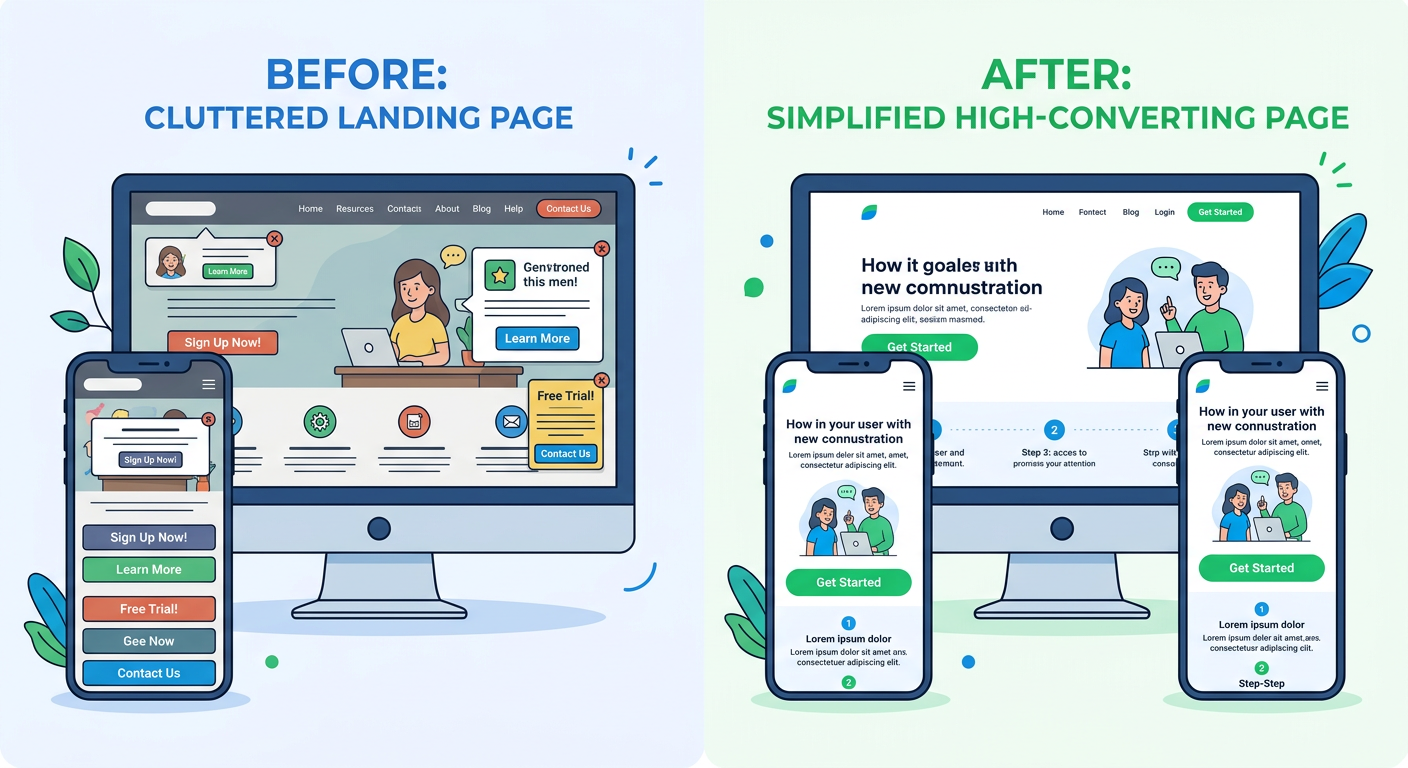
Why Is My Conversion Rate So Low? Common Root Causes
Here’s the thing, low conversion rates rarely have a single culprit. Usually you’ll find a mix of bad traffic, poor message fit, UX friction, trust issues, and technical problems. Below are the most common causes, with quick checks you can run today.
1. Traffic doesn’t match intent
If you’re attracting people who aren’t searching for your solution, they won’t convert. Check your acquisition channels, referral pages, and keyword targets. Organic traffic for awareness topics often looks great on analytics but converts poorly.
Quick test: segment conversions by source, campaign, and landing page. If one channel has high traffic and near-zero conversions, pause or rework the creative.
2. Weak or unclear value proposition
Visitors decide to stay in the first 3 to 7 seconds. If your headline, subheadline, and hero don’t clearly communicate the benefit and who it’s for, they leave.
Quick test: ask a colleague or friend to read your homepage for 5 seconds and tell you what you do and who it’s for.
3. Too many choices and poor information architecture
Cognitive overload kills conversion. Multiple CTAs, confusing navigation, or several competing offers dilute attention.
Quick fix: simplify the page so there’s one primary action per landing page. Use visual hierarchy to guide the eye.
4. Form friction and conversion blockers
Long forms, required fields that aren’t necessary, and unclear privacy signals create drop-off. Mobile users especially abandon forms that feel tedious.
Quick fix: reduce fields, enable autofill, add progress indicators, and explain why you ask for each piece of information.
5. Lack of trust signals
No testimonials, proof of results, security badges, or case studies? People hesitate before handing over email, credit card, or time.
Quick test: add one client logo strip, a short testimonial with name and role, and a privacy line near the CTA. See if conversions improve.
6. Slow page speed and UX bugs
Even a one-second slowdown can reduce conversions. Technical issues like broken images, JS errors, or mobile layout problems kill trust and usability.
Quick test: run a page speed check and mobile render test. Fix the biggest performance wins first, like compressing images and deferring nonessential scripts.
7. Mismatch between ad/landing page and promise
If your ad or email promises X and the landing page delivers Y, visitors feel misled. Alignment between source messaging and landing page is critical.
Quick fix: ensure headlines, visuals, and offers match end-to-end from first click to sign-up.
8. Poor or missing segmentation and personalization
Generic pages convert less than tailored experiences. Even simple personalization by traffic source, geography, or industry can boost conversion.
Quick idea: serve a variant of the hero headline for visitors from paid search vs organic social.
9. Analytics and attribution blind spots
Sometimes conversions are happening offline or through another path, but analytics aren’t set up to track them. You might be blaming the wrong page.
Quick test: validate analytics events, test form submissions end-to-end, and check server logs for hidden success signals.
A Simple Diagnosis Framework You Can Run in 48 Hours
- Check acquisition quality: Filter sessions by channel and landing page, compare conversion rate by source.
- Quick UX scan: 3-second headline test, mobile render check, and form length audit.
- Trust and social proof: add one clear testimonial and one recognizable logo to the hero.
- Speed wins: compress hero images, enable browser caching, defer noncritical JS.
- Micro-tests: change CTA copy, reduce fields, or swap a headline using A/B or even sequential traffic splits.
These steps prioritize high-impact, low-effort changes so small teams get results without a full redesign.
Quick A/B Tests That Often Move The Needle
- Headline variation with clearer benefit vs feature.
- Primary CTA color and copy test, for example “Start Free Audit” vs “Get My Free Audit”
- Form length: 3 fields vs 6 fields.
- Add a short video vs static hero image.
- Social proof block vs no proof block above the fold.
Run each test long enough to hit statistical usefulness, or run sequential tests and prioritize wins by effect size.
Tools And Resources For Small Teams
- For instant audits and lead capture widgets, run a free AI site audit with Auditsky to produce quick, embeddable reports and conversion-focused recommendations. See the free audit at Auditsky home.
- For step-by-step content and AI assistance, try the Marvlus assistant for content and SEO task automation at Auditsky’s Marvlus page.
- If you need context on audit ROI and how interactive audit widgets lift leads, read the Auditsky strategy article on audit ROI for agencies.
Prioritization Cheat Sheet for Limited Dev Resources
- Tier 1 (Immediate, high ROI): headline, CTA clarity, form fields, hero social proof, compress hero images.
- Tier 2 (Next sprint): landing page alignment by channel, add 1–2 testimonial videos, set up basic personalization.
- Tier 3 (Longer term): new funnel experiments, checkout UX overhaul, performance budget and Core Web Vitals improvements.
Frequently Asked Questions
How do I calculate conversion rate correctly?
Divide the number of goal completions by the number of unique visitors or sessions for the time period, then multiply by 100 to get a percentage. Define the goal clearly, for example a lead form, trial signup, or purchase.
What is a “good” conversion rate?
It depends on channel, industry, and funnel stage. Typical site-wide rates range from 0.5 to 5 percent, but landing pages with tight intent often convert higher. Benchmark against your industry but prioritize trend and uplift over absolute numbers.
Should I focus on traffic volume or conversion optimization first?
Both matter, but if your conversion rate is very low, improving conversion first is usually higher ROI. Increasing traffic into a leaky funnel often wastes ad spend.
How long should A/B tests run?
Run tests until you have enough visitors and conversions to reach statistical confidence, or use sequential testing for quick wins. Avoid stopping tests too early because small sample sizes can mislead.
Can small design changes really increase conversions?
Yes, small changes like clearer headlines, fewer form fields, or stronger trust signals can move conversions significantly, especially when your current rate is low.
How do I track improvements without a developer?
Use tag managers, simple event tracking in analytics, and embeddable audit widgets to capture leads. Tools like Auditsky offer plug-and-play widgets you can drop into pages with minimal dev work.
When should I hire a CRO specialist?
If you’ve run basic tests and still see no traction, or if revenue impact justifies the cost, bring in a specialist. But exhaust quick-win playbooks first; many conversion issues are simple fixes.
Ready To Turn Traffic Into Leads and Sales?
If you want a fast, objective diagnosis that you can embed on your site and use to convert visitors into warm leads, try an instant audit from Auditsky. The white-label audit widget helps agencies capture leads directly from landing pages and demonstrates clear next steps you can implement without heavy dev work. Start a free audit at https://auditsky.ai to see your highest-impact fixes.
Conclusion
Low conversion rates aren’t a mystery, they are signals. They tell you where messaging, UX, trust, or technical execution are misaligned with visitor expectations. Start with the prioritized checklist above: confirm traffic intent, clarify your value proposition, remove friction, add trust, and measure results. Small, iterative wins compound fast, and with the right experiments you’ll shift from guessing to predictable growth.