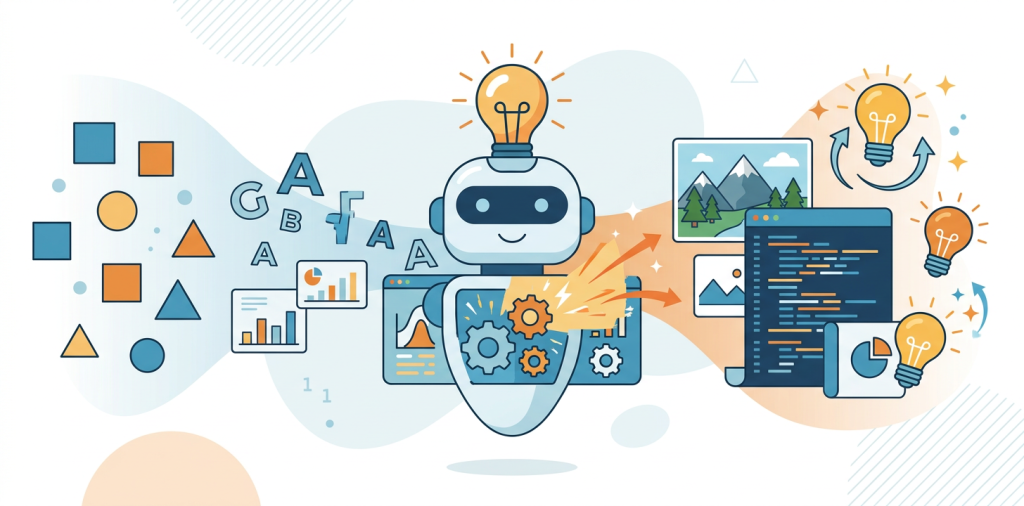
Generative AI is one of those terms people hear everywhere, but not everyone can explain it clearly. At its core, it refers to systems that can create new content, like text, images, audio, code, and video, based on patterns learned from data. If you are trying to define generative AI, the simplest answer is this, it is AI that doesn’t just analyze information, it generates something new.
That matters because it changes how teams work, how content gets made, and how fast ideas can become real assets. For marketers, founders, and website owners, generative AI is already reshaping content production, search visibility, and customer experiences.
What Is Generative AI?
Generative AI is a type of artificial intelligence designed to produce original outputs. Instead of only classifying data or making predictions, it learns patterns from large datasets and then creates new material that resembles what it has learned.
A few common examples include:
- Writing blog posts, emails, and product descriptions
- Creating images and illustrations
- Generating code snippets and software suggestions
- Producing voice, music, and video content
- Summarizing documents and answering questions
The key idea is creation. A traditional AI model might tell you whether an email is spam. A generative model can draft the email itself.

How Generative AI Works
Most generative AI systems are trained on large amounts of data. During training, the model learns statistical patterns, relationships, and structure. When you enter a prompt, it predicts what should come next, whether that is a word, pixel, note, or code token.
Training on patterns
The model studies examples and learns patterns without memorizing every piece exactly. This is why it can create fresh responses that feel human-like.
Using prompts as inputs
A prompt is the instruction or question you give the model. Better prompts usually lead to better results, because the model has clearer direction.
Generating new outputs
Once trained, the model can produce new combinations of ideas. It is not copying in a simple sense, it is synthesizing outputs from learned patterns.
Why Generative AI Became So Popular
Generative AI took off because it is useful in everyday work. People can use it to speed up writing, brainstorming, design, support, research, and coding.
It also became popular because the results are visible right away. You ask a question or request a draft, and the system responds in seconds. That immediacy makes it easier for teams to experiment and adopt.
For businesses, the appeal is obvious, lower production time, faster iteration, and more ways to scale content. For agencies and SEO teams, it can support workflows like keyword research, content briefs, optimization, and content refreshes.
Common Examples of Generative AI
Generative AI is not one single tool. It is a broad category that includes many different systems.
Text generation
This includes chatbots, writing assistants, and content drafting tools. They can help with blogs, social posts, landing pages, FAQs, and internal documentation.
Image generation
These tools create visuals from prompts. Brands use them for concept art, campaign mockups, and creative testing.
Code generation
Developers use generative AI to write functions, debug issues, and speed up repetitive tasks.
Audio and video generation
Some tools can create voiceovers, music, avatars, and short-form video content.
Generative AI vs Traditional AI
Traditional AI usually focuses on recognition, prediction, or classification. Generative AI focuses on creation.
Here is the difference in simple terms:
- Traditional AI: “What is this?” or “What will happen next?”
- Generative AI: “Create something new based on this input.”
Both are useful, but they solve different problems. Traditional AI helps identify patterns. Generative AI helps produce outputs.
Benefits of Generative AI for Businesses
If you run a website, agency, or content team, generative AI can save time and unlock new opportunities.
Faster content production
You can draft outlines, emails, social captions, and page copy much faster.
Better brainstorming
It is useful when you need topic ideas, headline variants, or campaign angles.
Lower production costs
Teams can produce more assets without adding as many manual hours.
Scalable workflows
Once you build a repeatable process, generative AI can help support content optimization at scale.
Risks and Limitations
Generative AI is powerful, but it is not perfect.
Accuracy issues
It can produce incorrect or outdated information. That means human review still matters.
Bias and inconsistency
Outputs can reflect bias in training data or vary from one prompt to the next.
Overreliance
If you use it without editorial oversight, your content can become generic or off-brand.
Privacy and compliance concerns
Businesses need to be careful about what data they share with AI tools.
The safest approach is to treat generative AI as an assistant, not a replacement.
How Generative AI Affects SEO and Content Strategy
For SEO teams, generative AI changes both opportunity and competition. It can help you create more useful content faster, but it also means more brands are publishing similar material.
That makes quality, originality, and technical SEO more important than ever. If your pages are thin, repetitive, or poorly structured, AI-assisted competitors may outrank you.
This is where a strong content strategy matters. You need unique insights, better internal linking, strong page experience, and topic depth. If you want to improve visibility, tools like auditsky.ai can help identify SEO gaps, content decay, and AI visibility opportunities.
Best Practices for Using Generative AI
Start with clear goals
Know whether you want speed, scale, ideation, or optimization. The goal shapes the workflow.
Review every output
Human editing is essential for quality, accuracy, and brand voice.
Use it for support, not shortcuts
Generative AI works best when it supports good strategy instead of replacing it.
Keep improving prompts
Better instructions usually mean better results.
Measure performance
Track engagement, rankings, conversions, and time saved so you know what is actually working.
FAQ
What is generative AI in simple terms?
It is AI that creates new content, such as text, images, code, or audio, based on patterns it learned from data.
Is generative AI the same as ChatGPT?
No. ChatGPT is one example of a generative AI tool, but generative AI is the larger category.
Can generative AI replace human writers?
Not fully. It can help draft and scale content, but humans are still needed for strategy, editing, fact-checking, and originality.
Is generative AI good for SEO?
Yes, if used carefully. It can speed up research and drafting, but SEO still depends on quality, relevance, technical health, and user value.
What industries use generative AI most?
Marketing, software, design, education, customer support, media, and eCommerce are among the most active users.
What is the biggest risk with generative AI?
The biggest risk is trusting outputs without review. Hallucinations, inaccuracies, and weak brand alignment can create problems.
Ready to Improve Your AI and SEO Visibility?
If you want to turn AI into a growth advantage, start with your website foundations. Strong content, clean technical SEO, and better internal linking make every AI-assisted workflow more effective.
Audit your site, find what is holding you back, and fix the pages that matter most. If you are ready to improve rankings, traffic, and conversions, visit auditsky.ai and see how a smarter audit can guide your next move.
Conclusion
To define generative AI simply, it is technology that creates new content from learned patterns. It is already changing how teams build content, solve problems, and scale digital work.
The businesses that benefit most will not be the ones using it blindly. They will be the ones combining AI speed with human strategy, quality control, and strong SEO fundamentals.