

What does it mean to define LLM in a way that actually makes sense? At its simplest, an LLM is a large language model, a type of AI trained to understand and generate human-like text. If you have used ChatGPT, summarized a document, drafted an email, or asked an AI tool a question, you have already interacted with one.
The tricky part is that the phrase gets thrown around a lot, often without much context. So let’s break it down clearly, explore how LLMs work, and show you why they matter for SEO, content strategy, and AI search visibility.
Define LLM in Plain English
An LLM, or large language model, is an AI system that learns patterns from huge amounts of text. It predicts the next word, phrase, or token based on what came before, which is why it can write, answer questions, summarize, and rewrite content in a surprisingly natural way.
Here’s the simplest way to think about it: an LLM is not “thinking” like a human. It is recognizing statistical patterns in language and using them to generate the most likely response. That’s why it can sound smart, but also occasionally make mistakes.
What the acronym stands for
- Large means the model has many parameters, which are the internal settings it uses to learn patterns.
- Language means it works with words, sentences, and text-based data.
- Model means it is a trained system that can make predictions and generate output.
How LLMs Work Behind the Scenes
LLMs are trained on massive datasets that may include books, articles, websites, code, and other text sources. During training, the model learns relationships between words and ideas, like how certain phrases tend to appear together.
When you ask a question, the model does not search a database the same way a traditional system does. Instead, it uses what it learned during training to generate a response token by token. That is why responses can be fluent, fast, and flexible.
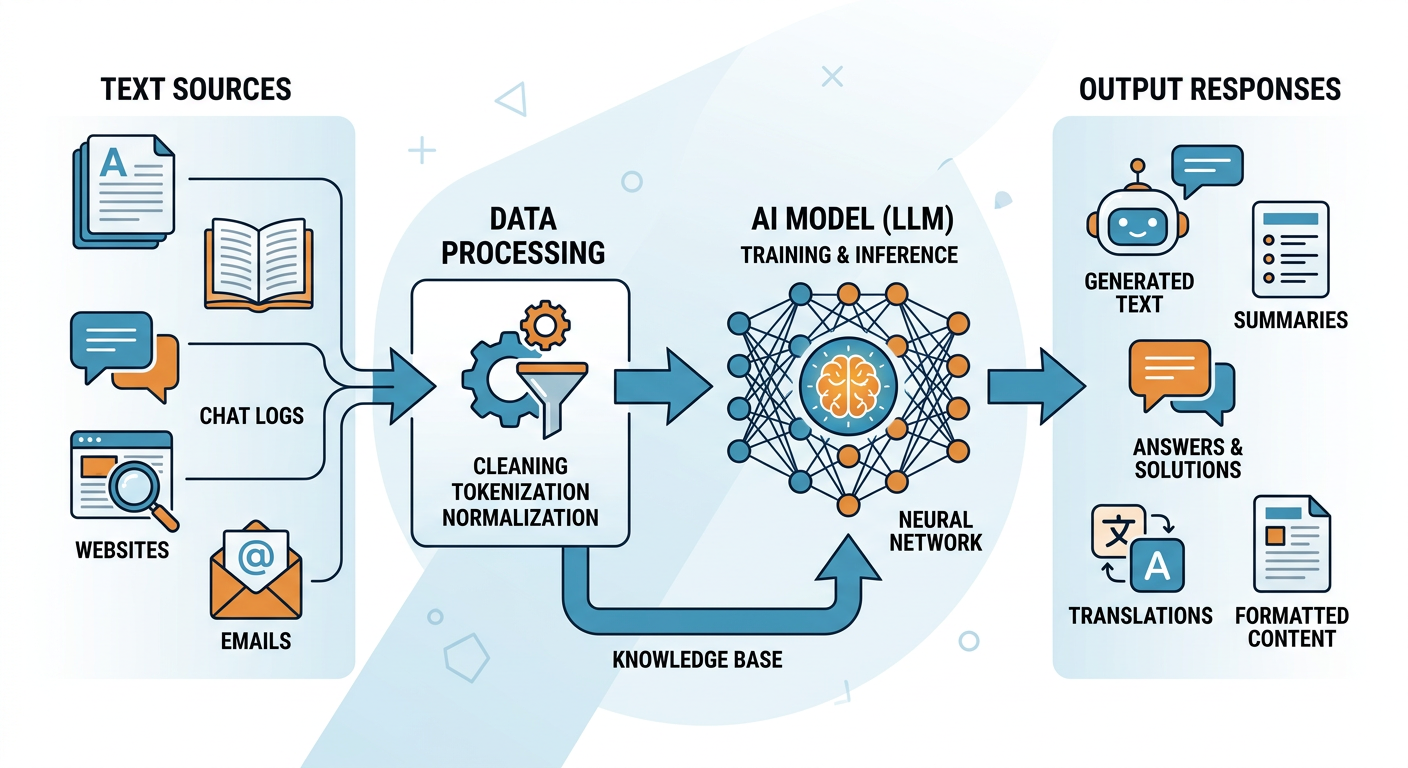
Training vs. prompting
Training happens before you ever use the model. Prompting happens when you give it instructions, a question, or context.
That difference matters because the quality of the prompt influences the quality of the answer. A well-structured prompt usually produces better output than a vague one.
Why LLMs can make mistakes
LLMs are powerful, but they are not perfect. They can hallucinate facts, misunderstand context, or produce outdated information if they are not connected to current sources.
That is why human review still matters, especially for business content, legal topics, healthcare, finance, and anything where accuracy is critical.
Why LLMs Matter for SEO and Content Marketing
If you run a website, an LLM is no longer just a tech concept. It is part of how people discover, evaluate, and consume information online.
Search engines, AI answer engines, and content tools are all increasingly influenced by language models. That means your content needs to be written clearly, structured well, and optimized for both humans and AI systems.
The impact on organic visibility
LLMs help power modern search experiences, content summaries, and conversational answers. If your site content is thin, unclear, or poorly organized, it is less likely to be selected or cited by AI-driven systems.
That is where strong content architecture, internal linking, and topical depth become valuable. If you want to improve how your site performs in both search and AI results, a service like AI visibility audits can help identify the gaps.
The impact on content creation
LLMs can speed up brainstorming, outlines, meta descriptions, FAQs, and content refreshes. But they should support your strategy, not replace it.
The best results come when you combine AI efficiency with human expertise, brand voice, and real subject-matter insight.
Common Use Cases for LLMs
LLMs are useful in many different workflows, especially for teams that publish content or manage digital marketing.
Content drafting
They can generate first drafts, outlines, summaries, and variations of copy. This helps teams move faster without starting from a blank page.
Customer support
Many businesses use LLMs to power chat assistants, help center responses, and support routing. This can improve response time and reduce repetitive work.
Research and summarization
LLMs are great for turning long documents into shorter summaries. They can also help compare ideas, extract themes, and organize messy information.
SEO workflows
They can assist with keyword clustering, content briefs, title ideas, and schema planning. Used carefully, they make technical SEO and content strategy more efficient.
LLM vs Traditional Machine Learning
A traditional machine learning model usually performs one specific task, such as classifying spam emails or predicting a score. An LLM is broader, since it can handle many language tasks with the same core architecture.
That flexibility is part of what makes LLMs so important. Instead of building a separate tool for every writing task, you can use one model for many different language-based jobs.
What Makes a Good LLM
Not all LLMs are equally useful. A strong model usually balances several things:
- Accuracy
- Speed
- Context length
- Safety
- Reasoning ability
- Ease of use
For business use, reliability matters just as much as creativity. A flashy response is not helpful if it is wrong or off-brand.
How Businesses Should Use LLMs
The smartest approach is to treat LLMs like a productivity layer, not a replacement for strategy.
Use them to accelerate tasks, but keep humans in charge of:
- Final fact checking
- Brand messaging
- Editorial quality
- Conversion strategy
- SEO prioritization
If you want AI to support growth, start with the workflows that already cost you the most time. That often includes content refreshes, page optimization, and competitive research.
Why Understanding LLMs Helps You Make Better Marketing Decisions
Once you truly define LLM in practical terms, it becomes easier to see where it fits in your business. You stop treating it like magic and start using it like a tool.
That mindset helps you create better content, ask smarter questions, and build systems that work with AI instead of against it. It also helps you stay ahead as search continues shifting toward AI-assisted discovery.
FAQ
What does LLM stand for?
LLM stands for large language model. It is an AI system trained on text data to understand and generate language.
Is an LLM the same as AI?
Not exactly. An LLM is one type of AI, focused specifically on language tasks like writing, summarizing, and answering questions.
Can an LLM replace writers?
No. It can help writers work faster, but it still needs human judgment, editing, and strategy to produce strong content.
Why do LLMs sometimes give wrong answers?
They predict likely language patterns, not truth. Without strong grounding or verification, they can produce confident but inaccurate output.
Are LLMs useful for SEO?
Yes, especially for outlines, content updates, keyword research support, and scaling workflows. But they work best when paired with SEO expertise.
How is an LLM different from a chatbot?
A chatbot is the interface. An LLM is often the engine behind it. The chatbot lets you interact with the model in a conversational way.
Should small businesses use LLM tools?
Yes, if they use them wisely. Small teams can save time and improve output, especially with content creation, support, and website optimization.
Improve Your AI and SEO Visibility
If you want your content to perform better in search and AI-powered answers, start with a clear strategy. Focus on helpful structure, strong internal links, and pages that answer real user questions.
Auditsky helps businesses identify SEO issues, content gaps, and AI visibility opportunities so they can grow faster with less guesswork. Visit auditsky.ai to see how a focused audit can improve your site.
Conclusion
To define LLM simply, it is a large language model, an AI system trained to understand and generate text. But the real value is in knowing how it works and where it can support your business.
Used well, LLMs can make your content faster, smarter, and more scalable. Used carelessly, they can create noise. The difference is strategy, review, and a clear understanding of the tool.