
The fastest way to waste good content is to publish it without knowing whether search engines and AI assistants can actually understand it. That’s where an AI SEO audit checklist becomes useful, because it helps you spot the gaps that quietly drag down rankings, visibility, and conversions.
If you run an agency, manage a client site, or wear too many hats on a small marketing team, you do not need a bloated framework. You need a practical system that shows what to fix first, what matters most for AI visibility, and how to turn audit findings into revenue.
What an AI SEO Audit Checklist Should Cover
An effective audit should do more than scan keywords and broken links. It should evaluate how your site performs across traditional search, AI search, and user experience, because those three areas now overlap more than ever.
Here’s a clean way to think about it:
- Can search engines crawl and index the site efficiently?
- Can AI systems understand the content clearly?
- Can users quickly trust the page and take action?
- Does the site support lead generation, not just traffic?
That last point matters. A site can rank and still fail to convert.
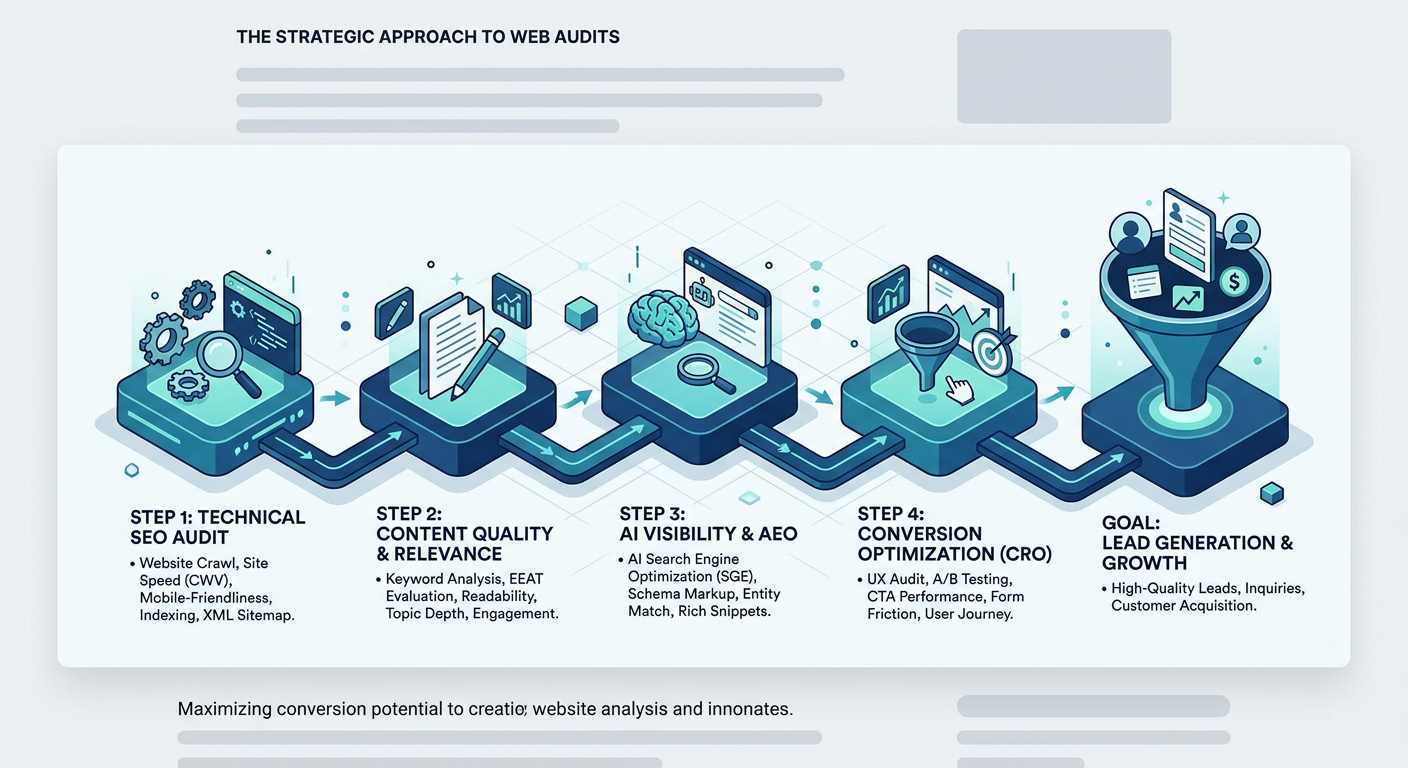
1. Technical SEO and Crawlability
Start with the basics, because no amount of clever content can fix a broken technical foundation. Check robots directives, XML sitemaps, canonical tags, redirect chains, duplicate pages, indexability, and internal linking structure.
Pay special attention to page speed, Core Web Vitals, mobile usability, and JavaScript rendering. If important content loads late or depends heavily on scripts, both search engines and AI tools can miss key context.
2. Content Quality and Search Intent
Next, review whether each page matches the intent behind the query. Ask yourself if the page is educational, transactional, comparison-based, or conversion-focused, then make sure the structure matches that intent.
Look for thin pages, overlapping topics, outdated claims, and content that tries to do too many jobs at once. A strong content audit should identify pages to refresh, consolidate, expand, or remove.
3. AI Visibility Signals
This is where your AI SEO audit checklist gets more modern. AI systems tend to reward content that is clear, structured, specific, and easy to extract.
Check for:
- Clear H1 and heading hierarchy
- Short, direct answers near the top of pages
- Consistent terminology across the site
- Schema markup where appropriate
- Author bios, credentials, and trust signals
- Original insights that go beyond generic summaries
If you want to improve AI visibility, think like a system that needs confidence, not just keywords.
The Checklist, Step by Step
Use this audit sequence to keep the process simple and repeatable.
4. Indexation and Site Architecture
Check whether the pages you want indexed are actually being indexed. Then review how pages connect to one another through categories, hubs, and contextual internal links.
A shallow, logical architecture helps search engines understand priority and helps users move toward key conversion pages faster.
5. On-Page Optimization
Review titles, meta descriptions, headers, image alt text, and body copy. Your aim is not keyword stuffing. Your aim is clarity, relevance, and click-through potential.
Make sure the main topic is obvious within seconds. For AI search systems, the cleaner the language, the easier it is to quote or summarize accurately.
6. Conversion Path Audit
A lot of audits stop at rankings. That’s a mistake.
Check whether pages have:
- One clear primary call to action
- Low-friction forms
- Trust elements like testimonials or proof points
- Strong above-the-fold messaging
- Logical next steps for different user types
If traffic lands on the page and leaves confused, your SEO work is leaking value.
7. Competitor and SERP Comparison
Compare your pages against the current top performers. Look at content depth, format, media usage, internal linking, and how competitors answer the query.
Also review what Google and AI tools are surfacing for the topic. If the search results favor checklists, guides, or comparison tables, your content format should reflect that reality.
8. Accessibility and UX
Accessibility is not just a compliance issue. It affects usability, comprehension, and often content quality.
Review color contrast, keyboard navigation, heading structure, link labels, alt text, and reading flow. If a page is hard for humans to use, it is usually hard for machines to interpret cleanly too.
What to Prioritize First
If you have limited time or dev support, rank fixes by impact and effort.
Highest Priority Fixes
- Pages blocked from indexing
- Broken templates on important landing pages
- Duplicate titles and cannibalized topics
- Slow pages with poor mobile performance
- Weak or missing conversion paths
Medium Priority Fixes
- Content refreshes on high-value pages
- Schema improvements
- Internal link updates
- Better FAQs and summary sections
- Stronger trust signals
Lower Priority Fixes
- Minor copy polish
- Small layout tweaks
- Non-critical image optimization
- Nice-to-have design changes
That simple triage keeps your team focused on revenue-driving work instead of endless cleanup.
How to Turn Audit Findings Into Growth
An audit only matters if it changes what happens next. For agencies and in-house marketers, that means turning findings into a clear roadmap.
Assign each issue to one of four buckets:
- Fix now
- Fix next
- Monitor
- Ignore
Then tie each item to a business goal, like more qualified leads, better AI visibility, or stronger conversion rates. When you present the audit this way, clients and stakeholders understand the why, not just the what.
FAQ
How often should you run an AI SEO audit checklist?
A full audit every quarter works well for most sites, with lighter monthly checks for technical issues, content decay, and AI visibility changes.
What makes AI SEO different from traditional SEO?
Traditional SEO focuses heavily on rankings and clicks. AI SEO also focuses on whether content is easy for AI systems to understand, summarize, and trust.
Do small websites need an AI SEO audit?
Yes. Smaller sites often move faster, so a focused audit can create noticeable gains without a huge budget.
Is schema markup necessary for AI visibility?
It is not mandatory for every page, but it can help clarify entities, page purpose, and content structure.
What is the biggest audit mistake teams make?
They find issues but do not prioritize them. A good audit should lead to action, not a long spreadsheet that nobody uses.
Can one checklist work for both agencies and in-house teams?
Yes. The framework is the same, but agencies usually need a more client-friendly version with clear priorities and business impact.
Put This Checklist to Work
If you want better results, start with one site, one template, or one high-value page and audit it thoroughly. Then repeat the process across the rest of the site using the same framework.
If you need a faster way to find what is hurting rankings, AI visibility, and conversions, explore AuditSky. It is built to help you spot issues faster, prioritize what matters, and turn audits into real growth.
Final Takeaway
A strong AI SEO audit checklist is not just about fixing technical problems. It is about building a site that search engines can crawl, AI systems can understand, and visitors can trust enough to convert.
Keep the process simple, prioritize the highest-impact changes, and focus on outcomes that matter to your business, not just vanity metrics.