
If you want more traffic from ChatGPT, Gemini, and other AI tools, the answer is simple: make your site easy to understand, easy to trust, and easy to cite.
That is the real shift. Traditional SEO still matters, but AI systems reward clear answers, strong topical coverage, and content that is structured well enough to pull into a response. If your pages are vague, buried, or thin, they are far less likely to show up when users ask questions in AI search.
Here is the good news. You do not need a giant team or a huge dev budget to improve ai search visibility. You need a practical content and technical plan that helps both humans and machines find value fast.
What AI Search Visibility Actually Means
AI search visibility is how often your content appears, gets referenced, or influences answers inside AI-powered search experiences. That includes chat-based tools, search engines with AI summaries, and answer engines that synthesize information from multiple sources.
In plain English, it means this: when someone asks a question, does your site have the kind of content an AI system can confidently use?
If not, the system will usually choose a competitor that is easier to parse, clearer to trust, or better organized.
Start With Search Intent, Not Keywords
The fastest way to improve results is to match the exact question your audience is asking. AI systems are built around answers, so pages that solve one clear problem tend to perform better than broad, unfocused pages.
Do this first
- Pick one question per page.
- Write for one intent, not five.
- Answer the main question in the first 100 words.
- Add supporting detail only after the direct answer.
For example, if the query is “how to improve ai search visibility,” the page should not drift into unrelated topics like social media, branding, or general content marketing unless they directly support that goal.
Build Content AI Can Read Fast
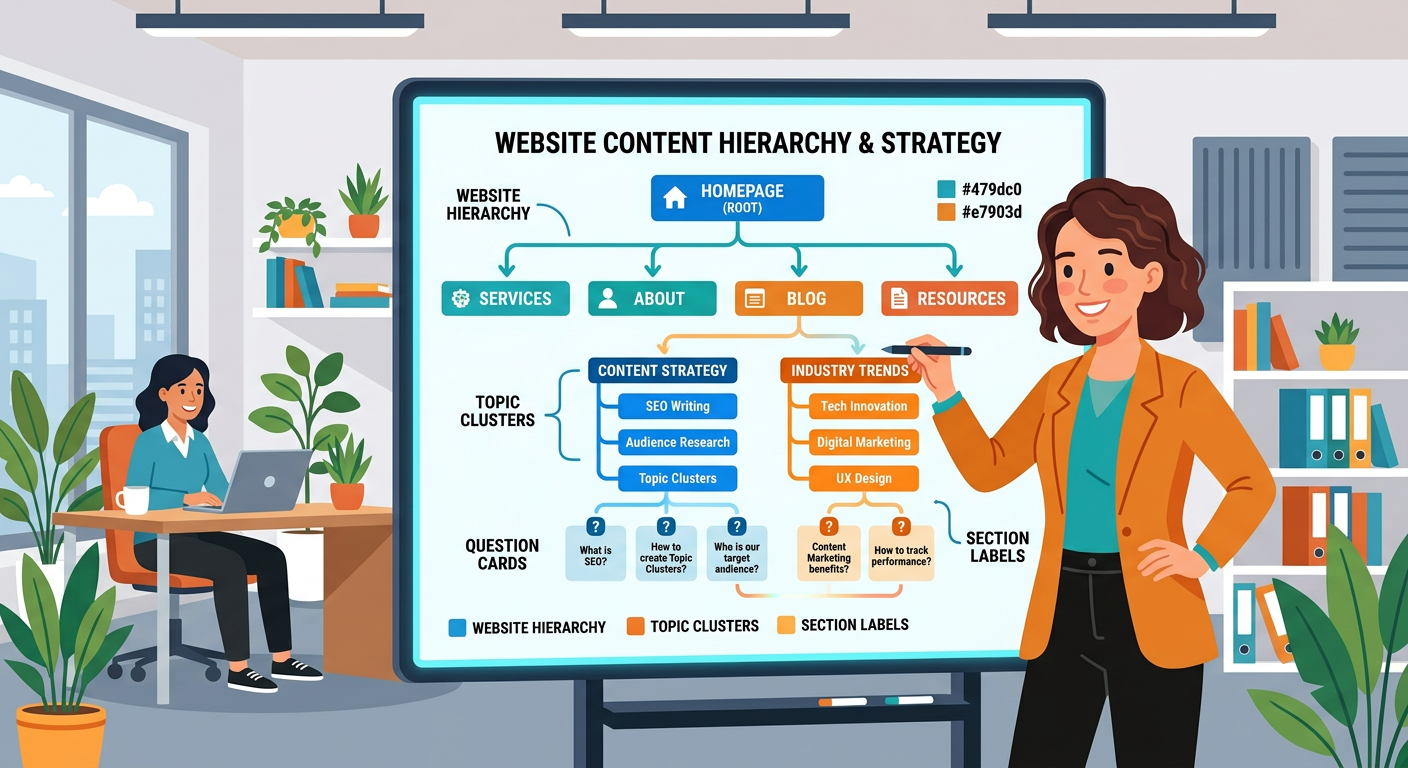
AI systems favor content that is cleanly structured. That means short sections, clear headings, direct language, and a logical flow.
Use a structure like this
- One page, one main question.
- A short answer near the top.
- Clear H2 sections that break the topic into steps.
- H3 subsections for examples, tools, or FAQs.
- Bullets where scanning matters.
This makes it easier for AI models and search engines to identify the core topic, supporting facts, and key takeaways.
Strengthen Topical Authority
AI search systems tend to trust sites that cover a topic deeply instead of superficially. If your site has one article on a topic and nothing else around it, it is harder to look authoritative.
A better approach
Create a small cluster of related pages that reinforce the same subject from different angles. For example:
- A main guide on ai search visibility.
- A page about content structure for AI search.
- A page about technical SEO for answer engines.
- A page about schema markup and structured data.
- A page about how to write citation-friendly content.
This helps signal that your site is a serious resource, not a one-off article.
Make Your Content Easy to Quote
AI systems often pull snippets, summaries, or short explanations. So your content should include concise statements that are easy to lift into an answer.
Best practices
- Use short definitions.
- Add clear list items.
- Write direct, factual sentences.
- Avoid fluffy intros and unnecessary jargon.
- Put important takeaways in standalone paragraphs.
A useful test is this: if a sentence were copied into an AI answer, would it still make sense on its own? If yes, you are on the right track.
Use Structured Data and Clean Technical SEO
Technical SEO still matters because it helps machines understand what your page is about. Schema markup, internal linking, crawlability, and page speed all support better visibility.
Focus on these basics
- Add schema where relevant, such as Article, FAQ, Product, LocalBusiness, or Organization.
- Make sure important pages are indexable.
- Keep site architecture shallow and logical.
- Improve page load speed and mobile usability.
- Use descriptive title tags and meta descriptions.
If a search engine cannot crawl or understand your page efficiently, AI systems are less likely to trust it as a source.
Improve Trust Signals Across the Site
AI systems prefer sources that look credible. That means your site should clearly show who you are, why you know the topic, and why a user should trust the information.
Add trust signals like these
- Author bios with real expertise.
- Clear About and Contact pages.
- Updated content dates when appropriate.
- Case studies, examples, and proof.
- External references to credible sources.
If your site looks thin or anonymous, it becomes much harder to stand out in AI-generated answers.
Focus on Helpful Answers, Not Just Traffic
A lot of website owners still write for rankings first and users second. AI search flips that order. The content that wins is usually the content that best solves the problem.
That means your pages should be practical, specific, and usable immediately.
Ask yourself
- Does this page answer the question clearly?
- Does it help a user take the next step?
- Does it cover the edge cases people actually care about?
- Does it feel credible enough to cite?
If the answer is yes, you are moving in the right direction.
Create Content That Matches Real Questions
One of the best ways to improve ai search visibility is to build around actual user questions, not guessed topics. Look at customer emails, sales calls, support tickets, Reddit threads, People Also Ask boxes, and search suggestions.
Then turn those questions into pages.
Examples of high-value question types
- What is the best way to do X?
- How do I fix Y?
- Why is Z happening?
- Which tool should I use for X?
- What is the difference between A and B?
These are the kinds of prompts AI tools are built to answer.
Make Internal Links Do More Work
Internal linking helps AI systems and crawlers understand relationships between pages. It also spreads authority through your site.
Link strategically
- From broad guides to supporting pages.
- From high-traffic pages to conversion pages.
- From old posts to newer, more complete content.
- Using descriptive anchor text that explains the destination.
Do not overdo it. Just make sure your most important pages are clearly connected.
Track the Right Metrics
AI search visibility is still evolving, so you should not judge performance only by rankings.
Watch these signals
- Branded search growth.
- Referral traffic from AI and answer engines.
- Featured snippet wins.
- Growth in non-branded organic traffic.
- Leads or conversions from informational pages.
- Mentions or citations in AI summaries when you can verify them.
If traffic is flat but qualified leads are rising, your AI visibility strategy may still be working.
A Simple 30-Day Plan
If you are early stage, keep it lean.
Week 1: Audit
- Identify your top 10 questions from customers.
- Review pages that are thin, vague, or outdated.
- Check technical basics like indexability and speed.
Week 2: Rewrite
- Improve intros and first answers.
- Add headings, bullets, and FAQs.
- Tighten language so every section has a purpose.
Week 3: Expand
- Build one or two related support pages.
- Add internal links between them.
- Add schema where it fits naturally.
Week 4: Measure
- Review traffic, engagement, and leads.
- Compare your pages against competitors.
- Update the next batch of pages based on what worked.
Common Mistakes to Avoid
Writing for algorithms instead of people
If the page reads like a robot wrote it, AI systems may not trust it either.
Trying to cover too much in one page
Broad content usually performs worse than focused content.
Ignoring technical basics
Great writing cannot fix crawl issues, broken links, or slow pages.
Publishing without proof
If your advice is strong, support it with examples, data, or experience.
FAQ
How long does it take to improve AI search visibility?
It depends on your current site quality, but many sites start seeing improvement after updating content structure, internal links, and trust signals over a few weeks to a few months.
Do I need new content or can I update old pages?
Both work. Updating existing pages is often the fastest win because the page already has some history, links, or traffic.
Is AI search visibility the same as SEO?
Not exactly. SEO still helps, but AI search visibility focuses more on clarity, trust, structured answers, and content that can be summarized or cited easily.
What kind of pages perform best in AI search?
Pages that answer one specific question clearly, use strong headings, and provide practical value tend to perform best.
Does schema markup really help?
Yes, especially when it helps clarify page type, organization, FAQs, products, or local business details. It is not magic, but it helps machines understand your content.
Should small sites bother with this?
Absolutely. Small sites can move faster, publish clearer content, and build topical authority without the baggage of huge outdated content libraries.
Get a Clearer AI Visibility Strategy
If you want to improve your AI search visibility without wasting time, start with your most important pages and make them easier to understand, trust, and cite. That one shift will outperform scattered tactics every time.
If you want help finding the pages that matter most, improve them faster, and turn more organic attention into leads, visit AuditSky. It is a simple place to start if you want a clearer content and SEO roadmap.
Final Takeaway
AI search is not about gaming a new algorithm. It is about becoming the best answer in a format machines can read quickly.
Keep your pages focused, structured, trustworthy, and genuinely useful. Do that consistently, and you will give your site a much better chance of showing up where modern search is heading.