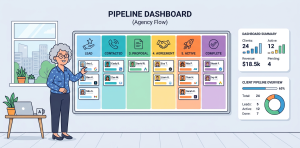
Agencies do not need another dashboard full of vague scores. We need AI audit tools that turn technical findings, AI visibility signals, and content gaps into work clients can understand, approve, and pay for.
That distinction matters more as discovery shifts beyond classic search results. In 2025, Google said AI Overviews had reached more than 1.5 billion monthly users, while OpenAI reported that ChatGPT served more than 800 million weekly users by late 2025. For SEO, AEO, GEO, and digital marketing agencies, AI visibility is quickly becoming part of the baseline conversation, not a side experiment. Google and OpenAI
The best AI audit tools for agencies help us do three jobs at once: win qualified prospects, identify practical fixes, and prove progress across client portfolios. Here are the platforms worth evaluating, plus a lean rollout plan for an early-stage agency building this service line.
The Shortlist at a Glance
The right platform depends on whether we need prospecting, deep SEO data, AI mention monitoring, or client-ready reporting. Many agencies will ultimately combine one audit and lead tool with one advanced intelligence platform.
| Tool | Best For | Standout Strength | Watch-Out |
|---|---|---|---|
| Marvlus | White-label audits and lead capture | Branded audits, client management | Less suited to enterprise-scale research |
| Semrush AI Visibility | Full SEO and AI workflow | Broad SEO data plus AI monitoring | Costs rise per domain and user |
| Ahrefs Brand Radar | Competitive AI research | Multi-platform share of voice | Premium pricing for full coverage |
| OtterlyAI | Affordable AI monitoring | Multi-client workspaces and GEO audits | Some engines are paid add-ons |
| Profound | Advanced AEO programs | Prompt tracking plus content workflows | Best features require larger budgets |
1. Marvlus for White-Label Audits That Generate Leads
Marvlus is our best pick when the audit itself needs to function as a sales asset, not merely an internal diagnostic. It combines AI and SEO visibility checks with branded reports, embedded audit widgets, shareable links, lead capture, and client management.
For a newer agency, this solves a difficult early-stage problem: we need proof of expertise before a prospect commits to a call. A free audit embedded on a service page offers personalized value first, then gives our team useful context for the follow-up. The agency audit platform supports white-label presentation, while the free AI website audit checks content structure, topic depth, schema, clarity, and AI-readiness signals.
Best fit: SEO and GEO agencies that want a repeatable inbound offer, branded prospect reports, and a simpler path from audit to pipeline.
Trade-off: Agencies running highly technical enterprise audits may still want a specialist crawler or large SEO suite alongside it. Marvlus is strongest when clear recommendations, lead generation, and client communication are as important as the raw data.
2. Semrush AI Visibility for Full-Service Search Programs
Semrush is a strong choice when we already rely on a broad SEO suite and want AI monitoring in the same operational environment. Its AI Visibility Toolkit includes AI brand visibility reporting, custom prompt tracking, competitor analysis, prompt research, and AI readiness checks.
The platform is particularly useful for established agencies that need to connect AI visibility with keyword research, technical SEO, ranking reports, backlinks, and competitor intelligence. Semrush lists its AI Visibility Toolkit from $99 per month per domain on annual billing, while its bundled Semrush One plans begin at $199.95 per month. Semrush pricing and Semrush One details
Best fit: Agencies with multi-channel organic search retainers and teams that already know the Semrush workflow.
Trade-off: Budget discipline matters. Domain, prompt, report, and user requirements can add up quickly, so we would model costs by client before bundling it into a fixed-fee service.
3. Ahrefs Brand Radar for Competitive AI Visibility Research
Ahrefs Brand Radar is best when the key client question is, “Why are competitors showing up in AI answers when we are not?” It monitors AI visibility across platforms, supports share-of-voice comparisons, and helps identify cited pages and domains that influence answers.
This is valuable for competitive audits because it gives strategists a starting point for better recommendations. Instead of saying a client needs more authority, we can inspect the publishers, sources, content formats, and topics that appear around relevant prompts. Ahrefs says Brand Radar can track Google AI Overviews, AI Mode, ChatGPT, Perplexity, Gemini, and Copilot, with standalone platform access and prompt-tracking tiers available on top of paid plans. Ahrefs Brand Radar
Best fit: Agencies that sell competitive intelligence, content strategy, digital PR, and authority-building work.
Trade-off: It is a research-heavy platform. We still need a client-friendly action plan and a reporting workflow to turn the intelligence into retainable services.
4. OtterlyAI for Cost-Conscious AI Search Monitoring
OtterlyAI gives agencies a lower-cost way to monitor prompts, brand mentions, citations, sentiment, and GEO audit signals across multiple AI search experiences. Its agency setup includes workspaces for separate clients, unlimited team members, and reporting options through Looker Studio.
Its entry plan starts at $29 per month, while the Standard plan is listed at $189 per month and adds unlimited workspaces, API access, and broader reporting capabilities. The platform tracks ChatGPT, Google AI Overviews, Perplexity, and Copilot in its core plans, while Claude, Gemini, and Google AI Mode are optional add-ons. OtterlyAI pricing and agency features
Best fit: Agencies testing an AI visibility service without committing to enterprise software costs.
Trade-off: Track the add-ons closely. A low entry price can become less attractive if every client requires extra engines, large prompt volumes, and frequent exports.
5. Profound for Advanced AEO Delivery
Profound is designed for teams that want to turn AI visibility monitoring into an ongoing answer-engine optimization program. It supports prompt tracking, competitive insights, recommendations, and AI-assisted content workflows, which makes it especially relevant for agencies positioning AEO as a strategic service.
Its Starter plan is listed at $99 per month and focuses on ChatGPT tracking, while the $399 per month Growth plan includes three answer engines and content-oriented capabilities. Enterprise plans add broader engine coverage and multi-company tracking. Profound pricing
Best fit: Growth-minded agencies with clients that already understand AI visibility and can support a higher-value strategic retainer.
Trade-off: It is more than many early-stage agencies need on day one. We would choose it when the service model includes recurring prompt analysis, editorial optimization, and executive reporting, not just a one-time audit.
Build the Service Before You Buy the Stack
For an early-stage agency, the winning move is not to buy every platform. We should build a small, credible audit offer first, then add technology only when it makes delivery faster or our recommendations stronger.
Day 18 is a useful point in a progressive content strategy to make that shift. By this stage, we should have a clear niche, several core service pages, and enough educational content to demonstrate how we think. Now we need a mechanism that turns that expertise into conversations.
Start with one commercial offer, such as an “AI Visibility and SEO Audit for B2B SaaS” or “Local AI Search Audit for Multi-Location Brands.” Then build a five-step system:
- Create a free diagnostic. Embed a branded audit tool on the highest-intent service page.
- Audit one revenue page first. Focus on a service, product, category, or location page that can influence pipeline.
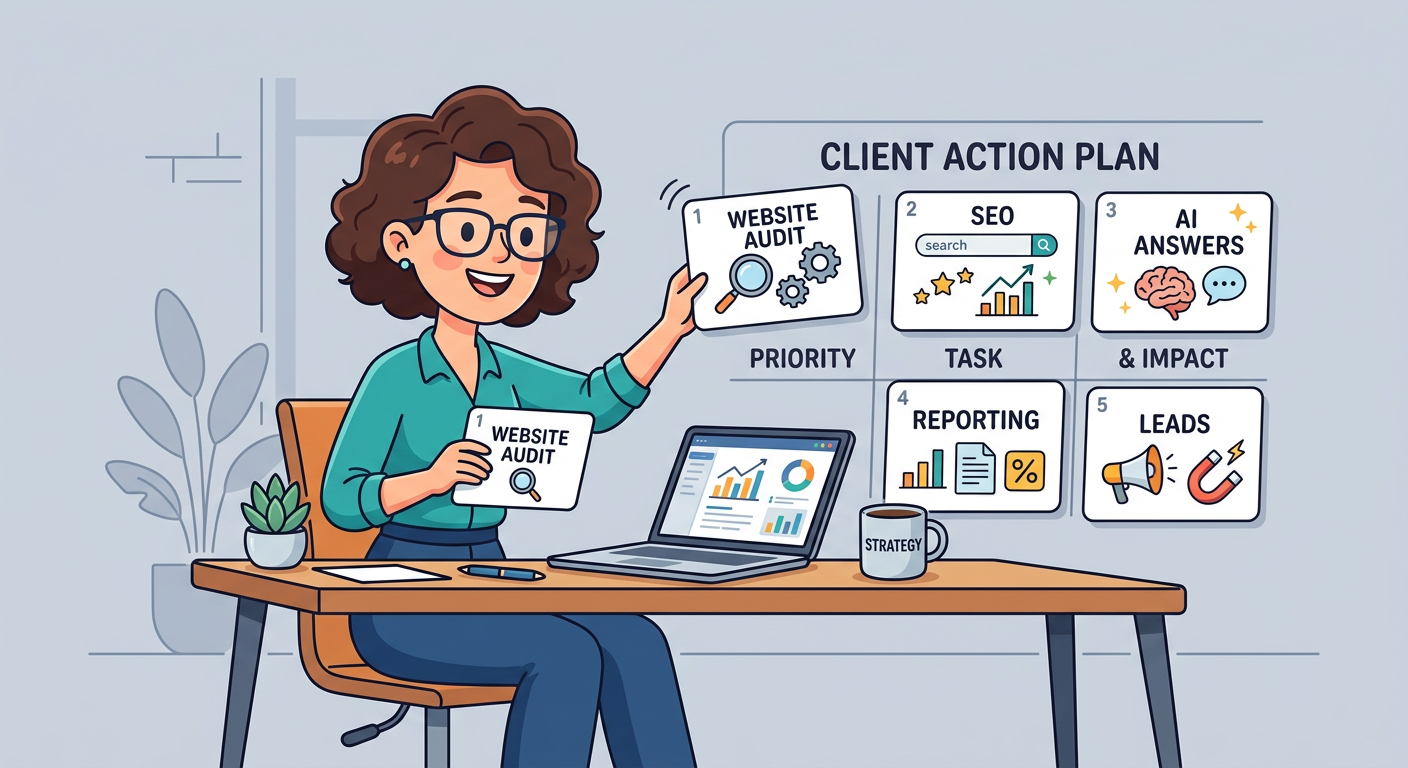
- Package the findings into three priorities. Separate quick fixes, content improvements, and authority-building work.
- Publish supporting content. Build three to five articles that answer the questions prospects ask after seeing the audit.
- Track a small prompt set. Begin with 10 to 20 high-intent prompts, not hundreds of vague queries.
This is also where keyword tracking earns its place. An agency-ready keyword tracking workflow helps us connect AI visibility initiatives to conventional rankings, clicks, and page performance. Clients should not have to choose between SEO and AI search. A strong program measures both.
What We Look for in an Agency AI Audit Tool
The best platform is one our team will actually use every week. Before purchasing, we would score each option against the following requirements.
A clear prospect-to-client path
Can we run an audit before a sales call, present it under our branding, and move the prospect into a structured follow-up process? If not, the tool may add analysis without adding revenue.
Recommendations that lead to billable work
A score alone is not useful. We need findings tied to deliverables such as rewriting a service page, adding FAQ schema, improving internal links, publishing comparison content, fixing crawl barriers, or creating original proof.
Multi-client organization
Separate workspaces, clean permissions, portfolio views, and exportable reports prevent an agency from rebuilding the process for every account. This becomes more important with every new retainer.
Sensible coverage and transparent pricing
Ask exactly which AI platforms are tracked, how often data refreshes, how prompt limits work, and what added domains cost. A tool that looks inexpensive for one client may not work economically across 20.
Traditional SEO foundations
AI visibility does not replace technical SEO. Clients still need indexable pages, helpful content, structured data, site speed, clean information architecture, and authority signals. The strongest audits show how these foundations support both search engines and AI systems.
Frequently Asked Questions
Do agencies need a separate AI audit tool if they already use an SEO suite?
Sometimes, yes. A traditional suite may cover rankings and technical issues well but offer limited prospecting, white-label audits, or AI prompt monitoring. We would add a specialist tool only when it creates a clear delivery or sales advantage.
How much should an agency charge for an AI visibility audit?
A focused audit can be a low-cost entry offer, while a strategic audit with competitor research, content recommendations, and a roadmap can support a much higher project fee. Price the audit based on strategic depth and the value of the follow-on implementation work, not on the number of pages crawled.
Can an AI audit guarantee a client will appear in ChatGPT or Google AI results?
No. No reputable platform can guarantee placement in AI answers. Audits improve the signals that make a brand easier to access, understand, validate, and recommend.
What should we audit first for a new client?
Start with the pages closest to revenue: homepage, core service pages, product pages, category pages, and key location pages. These pages usually reveal whether the brand is clear, credible, and aligned with buyer intent.
How often should we run AI visibility audits?
For active retainers, a monthly review is usually practical, with weekly checks for priority prompts or major campaigns. Run an additional audit after significant site changes, content launches, migrations, or brand repositioning.
Is AI visibility tracking useful for local businesses?
Yes, especially for service businesses that compete on location, reviews, expertise, and clear service coverage. We would combine AI prompt checks with local SEO fundamentals such as accurate business information, service-area pages, structured data, and reputation management.
Put Audits at the Center of Your Agency Pipeline
If we want prospects to see our expertise before they book a call, a branded audit is one of the clearest ways to do it. Explore Marvlus to add a white-label AI and SEO audit to your agency site, capture qualified leads, and give every sales conversation a more useful starting point.
The Strongest Tool Is the One Behind a Repeatable Offer
The best AI audit tools for agencies are not the ones with the longest feature lists. They are the tools that help us identify meaningful opportunities, explain them clearly, and turn recommendations into measurable client work.
Start with a focused offer, a short list of high-intent prompts, and a clear client reporting rhythm. As the service proves itself, add more advanced competitive research and monitoring. That approach keeps our costs controlled, our delivery sharp, and our agency positioned for the next stage of search.